
Sources for San Juan Capistrano Previous Residents
A house history works across several evidence eras. Current parcel and tax data identify the land. The recorder index supplies post-1982 instruments. Reverse directories provide published address snapshots from the 1960s through 2018. County directories, census schedules, newspapers, Mission registers, Archives files, and probate extend the trail when the modern web ends. The table keeps ownership, occupancy, and event evidence apart.
| Source | Years it covers | Where held | What it shows |
|---|---|---|---|
| RecorderWorks index | January 4, 1982-present | Orange County Clerk-Recorder | Recorded parties, document type, number, date, APN or legal trail |
| Pre-1982 instruments | Earlier county records | Recorder office and Orange County Archives | Book, page, instrument, and older title chain when references exist |
| Reverse directories | 1963, 1967, 1971, 1976, 1981, 1986, 1991, 1996-97, 2001-02, 2006, 2011, 2018 | City-hosted environmental appendix | Address, listed subscriber, business or phone entry, nonpublication mark |
| County city directories | 1926 and 1929 confirmed; broader runs have gaps | NARA and library or microfilm leads | Alphabetic or city listing clues |
| Census schedules | Public through 1950 | NARA and partner access | Age, relationship, birthplace, occupation, and household composition |
| Permits | 2007-present online; older appointment | San Juan Capistrano eTRAKiT and City Hall | Physical work, status, inspections, and project contacts |
A date in one row does not guarantee continuous coverage between rows. Treat the gaps as part of the source history. Previous residents may be visible in one layer and absent from the next.
Start With a San Juan Capistrano APN for Past Residents
The present APN is a better starting key than a former name. Search the San Juan Capistrano GIS by address or eight-digit APN, confirm the parcel polygon, and note city border, tract, historic, HOA, and legal-description clues. The Assessor adds current administrative context. A street label can change, but the parcel and legal description provide a bridge to older instruments.
The city GIS parcel source is explicitly ownerless. The free Assessor web form also omits owner names and accepts APN only. That is not a dead end. It tells the researcher to preserve the land key, then move to RecorderWorks, Public Works Land Records, the counter, or the Archives. Use the Tax Collector address autocomplete when the street spelling is uncertain, then compare the returned APN with the map.
Definition: A chain of title is the sequence of recorded transfers and related instruments affecting a parcel. It is not a list of every person who occupied the property.
Trace San Juan Capistrano Past Residents Through Deeds
RecorderWorks searches indexed Orange County documents from January 4, 1982 forward. Use the APN first. If the result is sparse, add a known party, legal description, recording date, or document type. Click the latest Grant Deed or Deed, note its recording grantee and grantor, date, instrument number, and property description, then search the seller's name in an earlier date window. A linked party search can expose the seller's other instruments.
- Locate the current parcel in GIS and copy the APN and legal description clues.
- Search RecorderWorks by APN, then narrow by document type and date.
- Identify a true conveyance, such as a Grant Deed, and separate it from a Deed of Trust, reconveyance, lien, or assignment.
- Search the prior grantor as a grantee in the earlier window and confirm the same APN or legal description.
- Repeat until the web index reaches the January 1982 boundary, then switch to book, page, instrument, office, or Archives material.
- Overlay directories, census, probate, obituaries, and permits to distinguish owner from listed occupant.
Recorder staff do not perform the title search by telephone, mail, or counter. The requester must build the chain. Official-copy instructions state the copy route; the research notes list $1 per page plus $1 certification per document. Request the document number before treating a copy order as ready.
The Orange County Grantor-Grantee Index is the source interface for the deed-chain search.
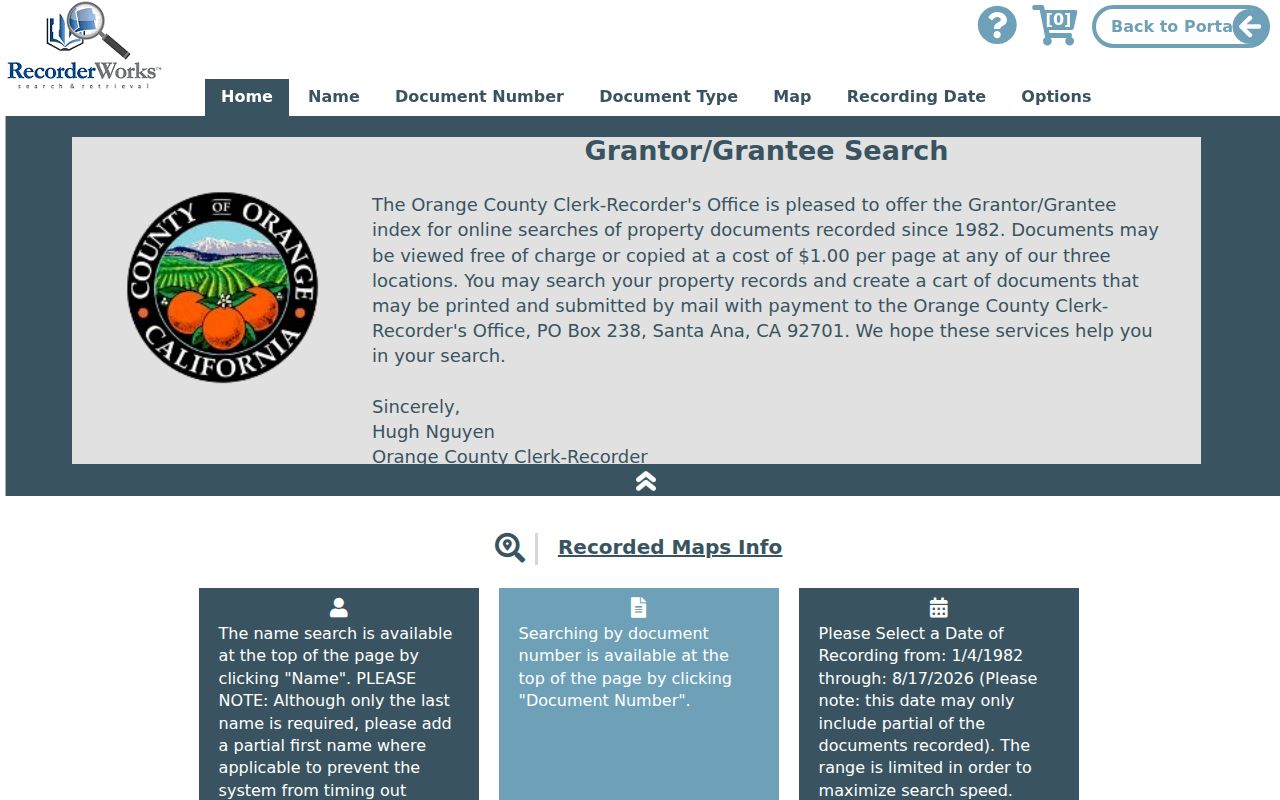
The grantor-grantee image shows the index route. The result is an instrument lead, not a scanned image or a completed title opinion.
San Juan Capistrano 1982 Boundary for Previous Residents
The January 4, 1982 cutoff is a practical boundary in the previous residents search. Post-1982 web indexing is detailed, but the recorder does not supply images through the free search. Earlier title work may require a known book, page, and instrument reference, an office request, or Orange County Archives. The archive gateway describes historic property, vital, newspaper, and government holdings, but it does not publish a complete item-level directory list.
Use the county service map and the official-copy instructions before visiting. Mail procedures, a self-addressed envelope, and a document identifier may be needed. If no identifier exists, consult a deed abstract, tract map, later instrument, tax map, probate file, or historical collection for the reference first. An older address alone may not be enough for staff to perform the search.
For land evolution, Orange County Public Works Land Records adds parcel, tract, survey, corner, annexation, and lot-line material. It provides the map context needed to decide whether a changed street line is the same parcel.
San Juan Capistrano Refinance Clues for Past Residents
A deed chain becomes noisy when every recorded instrument is treated as a transfer. A Deed of Trust records security for a loan. A reconveyance releases that security. Assignments move an interest. Notices of default, trustee sales, liens, easements, restrictions, maps, and lot-line adjustments each carry a different meaning. A Grant Deed or Deed is the transfer clue, but even that clue needs the APN and legal description.
| Instrument clue | How to treat it |
|---|---|
| Grant Deed / Deed | Possible conveyance; compare grantor, grantee, date, APN, and legal description |
| Deed of Trust | Loan security; not a transfer of occupancy |
| Reconveyance | Release of a security interest after a loan event |
| Lien or notice | Claim or process against property, not necessarily a new owner |
| Parcel or subdivision map | Land geometry and lot structure, not a household record |
Keeping this distinction is the central accuracy rule for previous residents. A finance event can make a parcel busy in the index while the owner and occupant remain unchanged.
San Juan Capistrano Reverse Snapshots of Previous Residents
The 2025 Legacy Ranch appendix provides a proven local address spine: 1963 and 1967 Pacific Telephone, 1971 through 1986 Haines Orange County, and 1991 through 2018 Haines South Orange County. Editions appear at 1963, 1967, 1971, 1976, 1981, 1986, 1991, 1996-97, 2001-02, 2006, 2011, and 2018. Walk backward one edition at a time. Preserve the street spelling, number, listing, and first or last appearance.
The local legend is essential. `XXXX` can mean no phone, no people, or a non-published phone. `600 XXXX` means the correct address but no other information. An intersecting street marker may help bridge a changed address. A blank row is not proof of vacancy. The reverse entry is a subscriber or address snapshot, not a complete household count.
The full collection story belongs to the San Juan directory book. This previous residents search uses the editions as a time spine, then adds census, newspapers, deeds, and probate for context.
San Juan Capistrano Directories and Census for Past Residents
Past residents often surface first as a directory listing and then become clearer in a census or newspaper. Pair 1929 with 1930, 1939 or 1941 with 1940, and 1947 or 1951 with 1950. Census schedules add age, relationship, birthplace, and occupation. They do not prove an address on every day between enumeration dates.
Keep separate columns for owner, listed occupant or subscriber, taxpayer, permit applicant, voter, litigant, licensee, decedent, heir, and household relationship. Search OCR with surname variants, initials, spouse names, address, and image browsing. If a directory mark says `XXXX`, copy the mark and its legend rather than silently converting it to “vacant.”
- Copy the address and directory year exactly.
- Find the nearest public census schedule and compare age, relationship, birthplace, and occupation.
- Search the next directory edition for continuity or a changed listing.
- Use a deed, obituary, probate item, or newspaper event to test the move, death, or ownership change.
This pairing keeps a historical previous residents result tied to a date and source rather than a vague claim about who lived there.
San Juan Capistrano Permits and Change
eTRAKiT adds a physical timeline from 2007 forward. Search a site address and inspect permit information, status, reviews, chronology, inspections, scheduled windows, corrections, notes, and public contacts. That evidence can show when a structure was altered, inspected, or licensed. It does not show that a permit applicant occupied the parcel. Older permit information and plans require a City Hall appointment, and plan review has restrictions on photography and stamped-plan access.
Compare a permit date with a deed, directory edition, and newspaper event. A remodel can explain why a house looks different in a later photo. A contractor's name can connect the project to a business. Neither clue replaces a dated resident or owner record. The city online archive begins in 2007, so earlier construction history needs paper files, historic-resource studies, or Archives research.
San Juan Capistrano eTRAKiT is the public search route. Use its address field as a date and work-history key, not as a residents list.
San Juan Capistrano Newspapers and Probate
Coastline Dispatch, 1931-1968, can close a gap with weddings, obituaries, clubs, schools, local ads, and community notices. OCPL provides in-branch digital access, while NewsBank resumes Orange County Register coverage in 1987. Probate can connect a decedent, petitioner, executor, heir, hearing, and last deed. A death record or obituary helps test the end of a directory appearance, but silence in a newspaper proves nothing.
Search the San Juan Historical Society archive for photographs, genealogies, oral histories, artifacts, and files. The Mission historic collection can reach back to 1776, while pre-1889 land or civil research may require Los Angeles County context. A property history grows strongest when a deed, directory, census, newspaper, probate, and photograph agree on the same address and time.
Note: Obituary and probate evidence can end a household trail, but they should not be used to infer the location of living protected people.
Before 1889 in San Juan Capistrano
Orange County formed in 1889 from Los Angeles County, so earlier civil land and court searches may use the predecessor county. San Juan was a pueblo in 1841, the Mission was sold to John Forster in 1845, and Lincoln's March 18, 1865 patent restored Mission title. The railroad arrived in 1887. These shifts create different evidence eras before the modern city's 1961 incorporation.
For a historic property, begin with the present APN, legal description, named adobe or landmark, and resource identifier. Then consult historic surveys, reverse directories, photographs, newspapers, census, deeds, probate, Mission or diocesan records, and the Archives. No verified local Sanborn year run or city-authored house-history guide was found, so do not promise a map sheet that the sources do not identify.
House-history use. Previous residents research is appropriate for genealogy, property history, and personal curiosity. Do not use a past address or name to stalk, harass, intimidate, or harm a living person.
The best house history leaves the gaps visible. A missing year, a coded directory row, or a protected record is a source limit, not an invitation to guess. Previous residents research is strongest when each name keeps its date and record role.