
San Juan Capistrano Directory Collections
San Juan Capistrano does not have one continuous city directory series. The strongest city directory search starts with the year and the type of entry needed. NARA confirms county directories that include San Juan Capistrano in 1926 and 1929. A Gale guide reports broader Orange County microfilm runs, while the local reverse sequence is documented in a 2025 city environmental appendix. Mission registers reach much farther back, but they record sacramental events rather than a neutral population count.
| Collection | Years or coverage | Where held | Access |
|---|---|---|---|
| Orange County city directories including San Juan | 1926 and 1929 confirmed | National Archives catalog and microfilm | Catalog and reel access |
| Orange County directory microfilm guide | 1903; 1924-1929; 1931-1934; 1936-1941; 1947-1948; 1951 reported | Gale holdings guide | Guide only, not proof of local shelf |
| Pacific Telephone and Haines reverse books | 1963, 1967, 1971, 1976, 1981, 1986, 1991, 1996-97, 2001-02, 2006, 2011, 2018 | City-hosted Legacy Ranch appendix | Address abstract and legend |
| Mission sacramental registers | Baptisms 1776-1958; marriages 1777-1857; deaths 1777-1915 | Mission, diocesan copies, and Santa Barbara inventory | Fragile originals, copies, or index |
| Federal census schedules | Public through 1950 in 2026 | NARA and partner databases | Household and relationship context |
The years overlap unevenly. A missing volume is a research gap, not evidence that no one lived in San Juan Capistrano during that year.
1963-2018 San Juan Capistrano Directory
The most unusual San Juan Capistrano city directory evidence sits inside a city-hosted Phase I environmental report for Legacy Ranch. Its Historical Information Gatherers abstract runs by street address and year, preserving 12 inspected editions from Pacific Telephone and Haines. This is a practical insider tip because neither the branch library nor Orange County Archives publishes a complete shelf list, publisher list, call number set, or guaranteed run.
Use the appendix as a documented address-history lead. It can show the first and last appearance of a listing, address spelling, business or telephone information when published, and cross-street markers. It does not replace the original volume, certify ownership, or reveal a complete household. Preserve the edition, page or row, address, and legend note in the research record.
The city environmental appendix is the source for the inspected run. A planning record can hold evidence that is not labeled as a city directory on a library web page.
Reading a San Juan Capistrano Directory Entry
A reverse or criss-cross entry is read from its arrangement and its legend. The local abstract runs by street address, then year. A printed original may also have an alphabetic section, abbreviations, an occupation line, or a spouse notation, but the inspected local abstract does not prove that those fields appear in every volume. Do not import a convention from one publisher into another.
| Visible clue | What it can mean |
|---|---|
| Edition year | The date of the directory snapshot, not a continuous occupancy period |
| Street and number | The address sequence used by the reverse section |
| Published name or business | A listed subscriber, occupant, or business entry when printed |
| XXXX | No phone, no people, or a non-published number according to the local legend |
| 600 XXXX | Correct address only, with no other information in that row |
| Cross-street marker | An intersecting street clue that can help bridge address wording |
- Criss-cross directory
- A reverse directory organized by address or telephone listing rather than only by surname.
- Abbreviation key
- The publisher's explanation of marks, initials, occupations, or listing status.
- Household lead
- A dated clue that points to a person or address and needs another source for confirmation.
The `XXXX` mark is the local quirk worth carrying into every transcription. A blank or coded row is not proof of vacancy.
San Juan Capistrano Mission Registers
Mission San Juan Capistrano was founded on November 1, 1776. Its registers record baptisms, marriages, and funerals, with copies and transcriptions extending across the eighteenth, nineteenth, and twentieth centuries. The historic collection also includes late-1800s photographs and the March 18, 1865 Abraham Lincoln patent restoring title to the Catholic Church. These records explain why a San Juan resident search may begin in a parish book rather than a modern city directory.
Mission records have a strong institutional point of view. Local historical material reports nearly 1,000 Indigenous neophytes and 1,649 baptisms in 1796, but the registers are not a complete neutral census of the valley. Pair a sacramental entry with land, civil, archaeological, oral-history, newspaper, and family sources. Spanish and Latin naming practices can change the form of a surname across indexes.
The Mission historic collection and the Santa Barbara sacramental inventory identify access routes. Fragile originals are rarely displayed, so a finding aid or copy may be the practical starting point.
San Juan Capistrano Directory Years and Census
A city directory names a listing at a particular snapshot. A census adds age, relationship, birthplace, and occupation context, though it also reflects a fixed enumeration date and its own transcription limits. Pair the closest directory and census rather than treating a gap between editions as a move. The federal 72-year rule means 1950 is public in 2026 and 1960 is scheduled for 2032.
- Record the directory year, publisher, exact address, name spelling, and any abbreviation or nonpublication mark.
- Choose the nearest census year: 1929 with 1930, 1939 or 1941 with 1940, and 1947 or 1951 with 1950.
- Compare age, relationships, birthplace, occupation, street wording, and nearby households without forcing a match.
- Search the next directory edition and note first appearance, last appearance, and any changed initials or surname components.
- Use deeds, probate, obituaries, and permits to separate ownership, occupancy, death, and physical change.
This method gives the San Juan Capistrano directory a time scale. It also keeps a listed subscriber from being mistaken for every member of the household.
Coastline Dispatch and San Juan Capistrano
The Coastline Dispatch, published for San Juan Capistrano from 1931 through 1968, fills the human space between directory and census entries. Its pages can carry weddings, obituaries, clubs, schools, advertisements, local businesses, and community events. OCPL digitized it from microfilm, but viewing, printing, and downloading are available only inside an OCPL branch. NewsBank adds the Orange County Register from 1987 and the Irvine World News from 2003, leaving a 1969-1986 period where Archives and the Historical Society matter more.
Newspapers are not a residents directory. They are event-driven and uneven. A notice may give a spouse, parent, school, club, or street clue, while silence proves nothing. Search surname variants, initials, compound names, and landmark names such as Los Rios or Mission Hill-Mission Flats. Preserve the issue date and page when a result helps identify a household.
The OCPL history and genealogy gateway is the source for the library database and newspaper access route.

The library's history and genealogy gateway shows why a directory search often needs newspaper and obituary databases beside the printed volume.
San Juan Capistrano Directory Research Rooms
Three local rooms carry different pieces of the city directory story. The San Juan Capistrano Library at 31495 El Camino Real has local history material and staff contact, with hours listed by OCPL as Monday through Thursday 10-7 and Friday through Saturday 9-5. Orange County Archives is at Old Courthouse Room 108, 211 W. Santa Ana Blvd., with hours Monday through Friday 9-12 and 1-4:30. The Historical Society offers researcher access to an archive begun in the early 1990s.
San Juan Capistrano Library
31495 El Camino Real
Local history and library databases
949-493-1752
Orange County Archives
Old Courthouse Room 108
211 W. Santa Ana Blvd.
714-834-2536
San Juan Historical Society
6,000+ photographs, genealogies, oral histories, artifacts, and files
Researcher access by program
The San Juan Capistrano Library page identifies the branch that holds and guides local-history research.
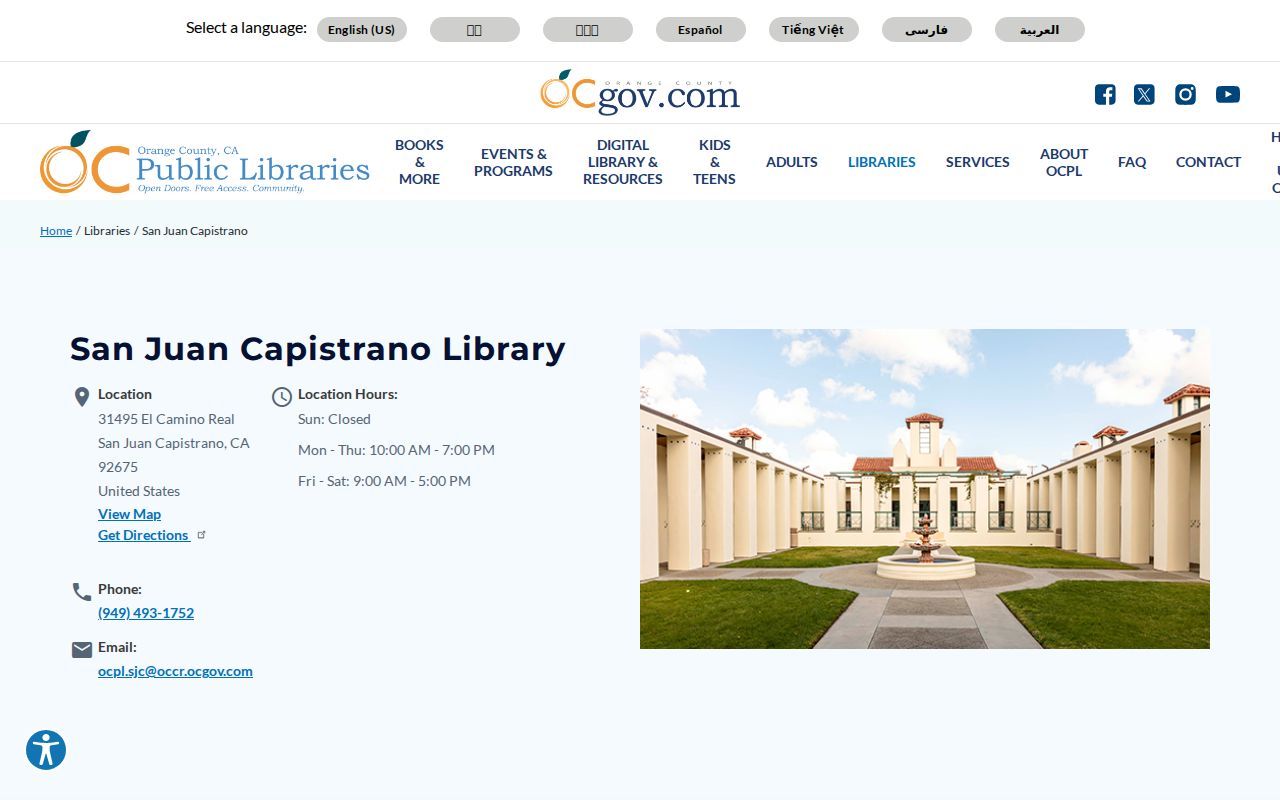
The branch page supplies the current location and contact route. Ask about the actual shelf year before assuming a particular volume is present.
Review the Orange County Archives gateway before relying on a general county holdings description.
The Archives image is a starting point for custody research. It does not turn a general holdings page into a shelf-level year guarantee.
Acjachemen Names in San Juan Capistrano
Family history in San Juan Capistrano can cross Mission registers, Indigenous Voices oral histories, land records, newspapers, photographs, and community files. The label “Juaneño” was attached during Mission involvement, while many people use traditional Acjachemen identification. A respectful city directory search should preserve the source's own wording and seek current community-narrated material rather than treating a colonial register as the whole local story.
Search both accented and unaccented forms, compound surname components, initials, Spanish and English variants, and a parent, spouse, sacramental event, parcel, or address. The California 2026 change allowing approved diacritics is a reminder that older and newer indexes may render the same name differently. A name match becomes stronger when the date, place, relationship, and record purpose agree.
OC Stories Indigenous Voices of San Juan Capistrano adds community-created images, documents, and oral histories. Pair that resource with Mission material, not underneath it.
San Juan Capistrano Library Timeline
The local library is part of the record-keeping history. The branch began at Union High School in 1921, moved to an adobe in 1937, moved again in 1940, and entered the Michael Graves building in 1983. OCPL began administering the new County Archives in 1983; the Archives moved to the Old Courthouse in 1991 and to the Clerk-Recorder in 1995. Knowing those moves helps explain why a directory or newspaper may be in a different room than expected.
| Year | Local records context |
|---|---|
| 1921 | San Juan branch begins at Union High School |
| 1937 | Branch moves to an adobe |
| 1940 | Branch moves again |
| 1983 | Michael Graves building opens; OCPL begins administering new County Archives |
| 1991 / 1995 | Archives moves to Old Courthouse, then Clerk-Recorder |
The current branch is at 31495 El Camino Real. The OCPL timeline records the institutional sequence; contact staff for shelf-level confirmation.
San Juan Capistrano Directory Shelf Limits
No complete yearly Polk run, local shelf call-number list, publisher list, or official San Juan-wide resident roll was verified. The NARA 1926 and 1929 entries prove inclusion, not every missing year. The Gale guide is a holdings aid, not proof that a reel is at the local branch. The inspected Haines material is an address abstract, not an alphabetic scan with invented spouse, occupation, or owner-renter fields.
Use the gap as a next step. Ask the library or Archives whether a specific year is held. Search the city environmental appendix for its documented reverse run. Use census, Coastline Dispatch, Historical Society files, Mission and diocesan copies, FamilySearch, and probate when a directory year is absent. The San Juan resident lookup route can then test a historical lead against a modern official record without collapsing the two eras.
Research habit. Write down the collection, publisher, edition year, address, page or row, access room, and legend before copying a name into a family history.
Note: A missing directory volume is a limit in coverage, not evidence that a San Juan household was absent.